Professional Japanese Knotweed Removal in Amesbury, MA
Japanese Knotweed in Amesbury, MA
Japanese knotweed can take hold in Amesbury’s riverfront, salt water habitats and residential landscapes, particularly along the Powwow River, drainage corridors, and property edges. Its aggressive root system enables rapid spread and persistent regrowth, often quickly returning after incomplete removal efforts. Targeted, professional treatment is essential in Amesbury to achieve lasting control and protect both residential properties and riparian areas.
Our Proven Eradication Process
1. Free Property Asssessment
At no cost to you, one of our licensed specialists will meet with you on your property to evaluate your goals, and provide a treatment plan with a straightforward quote.
2. Targeted Treatment
Once you approve the three-year Japanese knotweed treatment plan, we implement a strategic, phased approach designed to eliminate the rhizome network at its source.
3. Guarantee
Our Japanese knotweed treatment plans are backed by a one-year guarantee. If live knotweed returns in areas we treated within that period, we will come back and treat it at no additional charge.
4. Rescan Program
Following the one-year guarantee, properties with knotweed along their boundaries can participate in our Annual Rescan Program — safeguarding your investment and long-term property value.
Decades of Experience
We specialize in professional, guaranteed Japanese knotweed eradication for residential, estate, municipal, and commercial properties. Our work reflects decades of field experience, environmental knowledge, and exceptional customer care all supported by our written one-year Japanese knotweed eradication guarantee. Our applicators take special care around valued vegetation, understanding the time, care and resources our clients have invested in their landscapes.
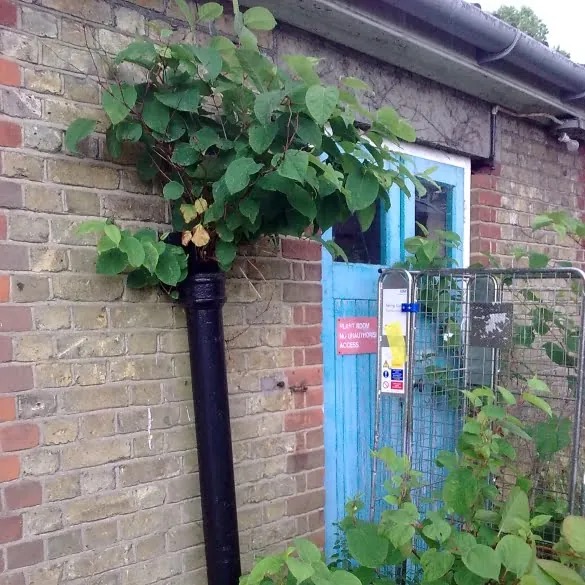
The rhizomes of Japanese knotweed can exploit small cracks in concrete, foundations, asphalt, and masonry, expanding over time and exerting pressure that widens gaps and weakens structural integrity.
Japanese Knotweed Formed a Landmark Legal Case in 2025
In 2025, in Trites v. Cricones, a jury and judge upheld a finding under Massachusetts consumer protection law (Chapter 93A) in favor of homebuyers whose property, in Pepperell, Massachusetts, was contaminated with Japanese knotweed, awarding six-figure damages and payment of attorney’s fees after the infestation was discovered post-closing due to the seller’s failure to disclose it.
Japanese knotweed can damage foundations, overtake landscapes, and significnatly reduce property values if allowed to dominate.
What is Japanese knotweed?
Japanese knotweed (Fallopia japonica) is a fast growing perennial invasive species introduced from Asia in the 1800s. It spreads aggressively through underground rhizomes that can extend 20+ feet horizontally and 7-10 feet deep or deeper in certain conditions.
How To Identify Japanese Knotweed
- Bamboo-like hollow stems
- Broad, shield-shaped leaves
- Cream-colored flower clusters (late summer)
- Dense thickets which, once mature, crowds out native plants allowing very little to grow beneath it
The true threat lies below ground. Even a small root fragment can regenerate into a new plant capable of reinfestation covering large areas.
Japanese Knotweed Diminishes Important Aquatic Ecosystems
Impacts to Terrestrial Ecosystems
Although often associated with moist areas, knotweed readily establishes itself in forest edges, floodplains, meadows, roadsides, residential landscapes, and other disturbed soils. Its extensive underground rhizome system allows it to spread rapidly and form dense colonies that are extremely difficult to control once established.
In forest edges and woodland openings, Japanese knotweed forms thick stands that can suppress native understory vegetation and prevent the regeneration of tree seedlings. In New England forests, this can interfere with the reproduction of important native species such as sugar maple, red maple, white ash, birch, oak, and other hardwoods. By shading out young seedlings and monopolizing soil resources, knotweed can disrupt forest regeneration and alter the long-term composition of New England forests and these ecosystems.
In floodplain and valley landscapes, knotweed can dominate large areas of land, replacing diverse plant communities that normally stabilize soil and provide habitat for wildlife. In meadows and old field habitats, it aggressively outcompetes native grasses and wildflowers that support pollinators, birds, and small mammals. As these native plant communities decline, the structure and biodiversity of the habitat can be significantly reduced.
Japanese knotweed also commonly establishes along roadsides, rail corridors, and other disturbed areas, where it spreads outward into nearby forests, fields, and residential landscapes. These corridors often act as pathways for the plant to move deeper into natural ecosystems.
Across New England landscapes, the spread of Japanese knotweed can significantly degrade terrestrial ecosystems by reducing plant diversity, suppressing native vegetation, and limiting the regeneration of important native trees such as sugar maple. This loss can have ecological and economic consequences, as species like sugar maple contribute not only to healthy forest ecosystems but also to regional industries such as maple syrup production, hardwood timber, tourism, and fall foliage economies.
As knotweed suppresses young tree growth and alters plant communities, it can gradually undermine the natural regeneration and characteristics of these valuable forest resources that many New Englanders depend upon.
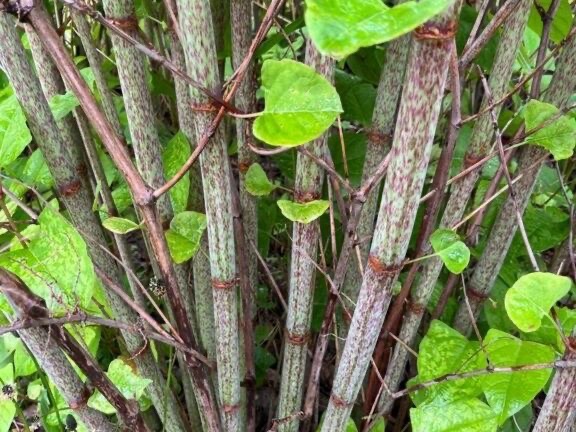
The thick bamboo like canes of Jampanese knotweed.
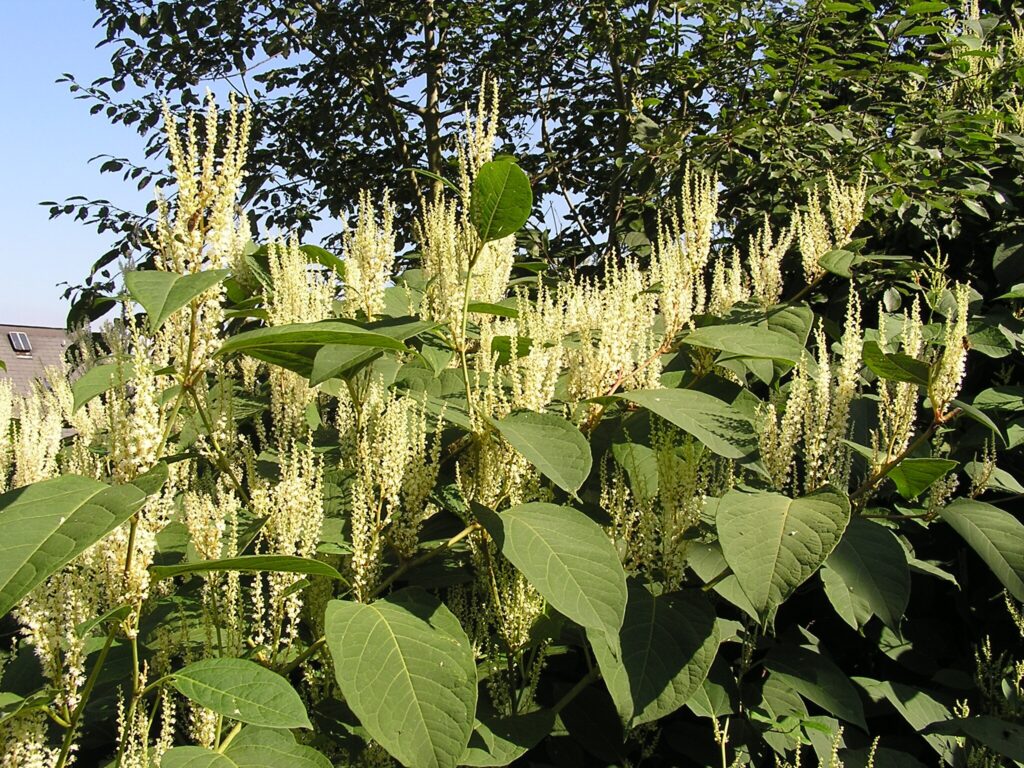
The white feathery plume like flowers of Japanese knotweed often appear in late-summer.
Native plants support complex food webs that support native plants and animals; invasive species often do not.
Decades of Experience
We’ve been serving Boston Metro West since 2000.
No Job Too Big or Small
From golf courses to tiny garden patches, we can handle it!
Licensed and Insured
We are fully licensed and insured in Massachusetts
Areas We Serve
We specialize in removing or eradicating garlic mustard, Asiatic bittersweet, Norway maple, autumn olive, black swallow-wort, multiflora rose, porcelain berry and Japanese barberry throughout Massachusetts, including the towns of Acton, Amesbury, Andover, Arlington, Bedford, Beverly, Billerica, Boxford, Burlington, Carlisle, Chelmsford, Concord, Georgetown, Gloucester, Harvard, Haverhill, Holliston, Hudson, Ipswich, Kensington, Lancaster, Leominster, Lexington, Littleton, Lunenburg, Methuen, Newbury, Newburyport, North Andover, North Reading, Pepperell, Reading, Rowley, Stoneham, Topsfield, Townsend, West Newbury, West Townsend, Westford, Weston, Wilmington, Winchester, Woburn and other surrounding towns.
We also specialize in removing or eradicating garlic mustard, Asiatic bittersweet, Norway maple, autumn olive, black swallow-wort, multiflora rose, porcelain berry and Japanese barberry in the counties of:
- Barnstable County, MA
- Bristol County, MA
- Middlesex County, MA
- Norfolk County, MA
- Plymouth County, MA
- Worcester County, MA

Seeking to help people and native vegetation thrive in New England landscapes.
Feel free to contact us with any questions about our services.